Antigen-expressing eDC lines
A defined antigen configuration and HLA context for your own experiments.
Explore eDC linesRenewable eDC technology applied to antigen target discovery and validation for immunotherapy programs.
The APC drug discovery platform tests whether a candidate antigen is presented, recognized by T cells and functionally relevant, before a program commits to a drug modality.
eDC technology is the cell system: renewable human dendritic cell lines that keep a mature, activated phenotype in culture and accept defined antigens and gene modifications. The platform is the workflow built on that system: antigen configuration, T cell priming, paired target functional assays and controls, reported as antigen- and HLA-dependent evidence.
Solid tumor programs depend on finding specific targets. Whatever the modality, the antigen has to be recognized accurately, and for T cell-based approaches that recognition occurs on peptide–HLA complexes. Dendritic cells also take up and spread tumor antigens, which supports responses beyond the first antigen. [13]
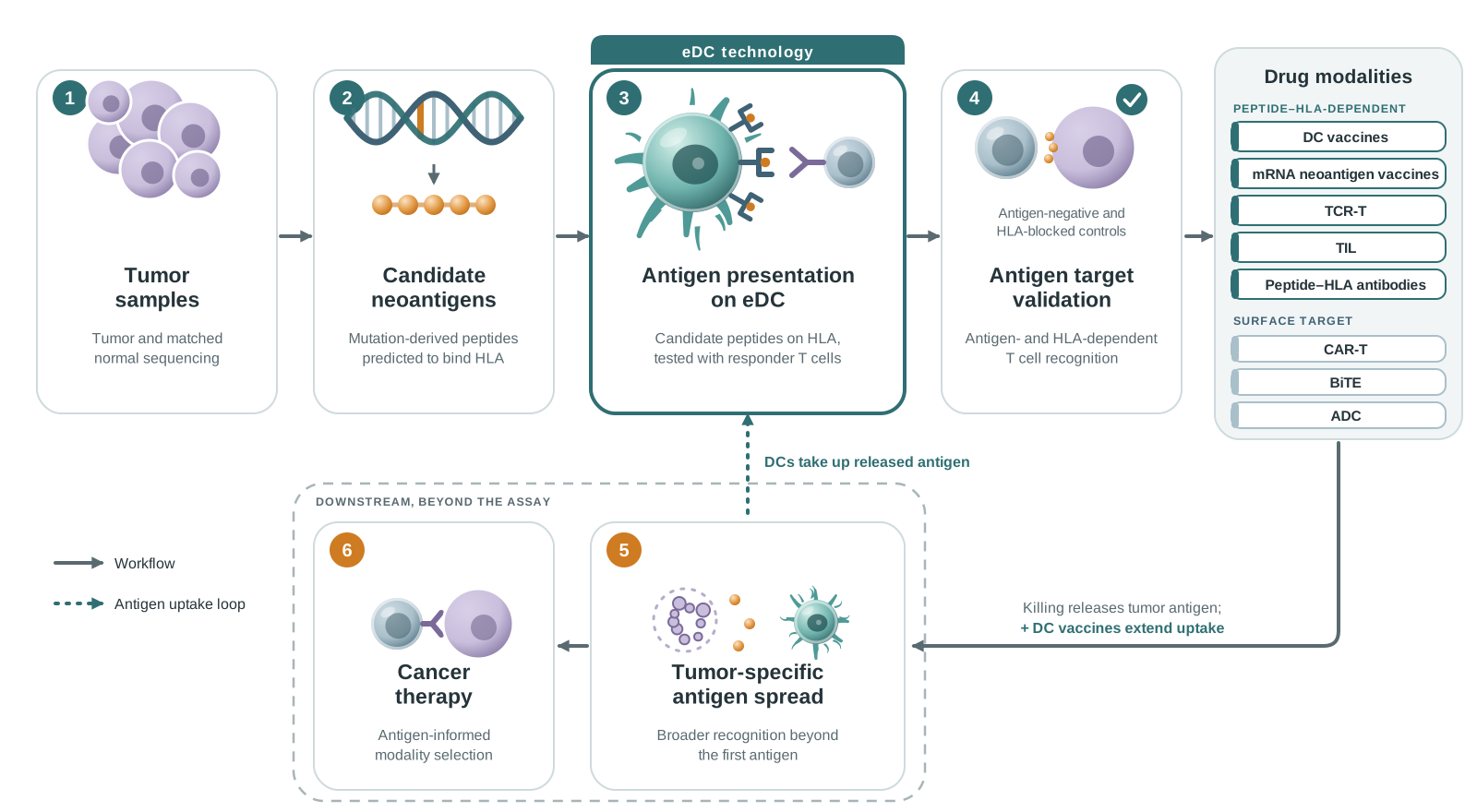
Each row names a bottleneck in antigen-directed discovery, the reason it limits decisions, and what the platform provides.
| Bottleneck | Why it limits decisions | What the platform provides | Evidence to request |
|---|---|---|---|
| Prediction is not immunogenicity | In the TESLA consortium, 37 of 608 tested neoantigen candidates (6%) were recognized by T cells. [12] | A functional presentation and recognition screen on one APC configuration | T cell response per candidate; irrelevant peptide and antigen-negative controls |
| APC supply varies by donor | MoDCs are generated from each donor’s monocytes, so APC quality enters the data as a variable. | A renewable line for repeated screens and replicates, with documented passage | Identity, phenotype and viability at the passage used |
| Recognition is HLA-restricted | A response to a peptide–HLA complex cannot be interpreted without the HLA context. | A defined HLA background; paired targets with and without antigen or HLA; HLA blockade | Matched HLA controls and the nonspecific killing background |
| Complex-specific binders need a validated target | An antibody, CAR-T, ADC or T cell engager against a peptide–HLA complex can be more specific than one against a surface protein, but only if the complex is immunogenic and presented. | Immunogenicity and HLA-dependent recognition of the candidate complex, with antigen-negative and HLA-mismatched controls | T cell response, plus presentation evidence such as immunopeptidomics or recognition of endogenous antigen targets |
| Immunomodulatory antibodies act on APC receptors | Agonist and checkpoint antibodies need an APC that expresses the target, and their effect shows in APC activation and T cell priming. | A mature, activated eDC with costimulatory molecules such as CD40, tested for the intended target before screening | Target expression on the line used; control antibody matched for isotype and Fc format |
| Antigen format changes processing | Peptide-loaded, gene-encoded and endogenous antigens can be processed differently. | eDC expressing the antigen as a gene or fragment, compared with targets expressing the endogenous antigen | Recognition of endogenous antigen target cells |
| APC biology is part of the mechanism | Costimulation, cytokines and inhibitory ligands on the APC shape priming. | Mature, activated phenotype and APC gene knockout or overexpression | Confirmed modification and a matched control line |
| One readout is not enough | Acute killing does not establish specificity, breadth or recall. | Multi-antigen configurations and serial stimulation within one system, as the design requires | Equal viable effector ratios and scheduled sampling |
The workflow is the same for a single antigen or a candidate panel. Inputs and acceptance criteria are agreed before work begins.
| Stage | Activity | Output |
|---|---|---|
| 01 Nominate | Candidate antigens from tumor sequencing, immunopeptidomics, expression data or prediction, with the relevant HLA types | Ranked candidate list and study question |
| 02 Configure | Antigen-expressing eDC, or custom eDC development from customer PBMCs with agreed gene modifications | Characterized APC with antigen expression and phenotype |
| 03 Prime | eDC stimulation of responder T cells under defined conditions | T cell populations for each antigen configuration |
| 04 Measure | Activation markers, cytokines, antigen-specific readouts and cytolysis of paired target cells, with HLA blockade and antigen-negative comparisons | Antigen- and HLA-dependent response data with controls |
| 05 Decide | Compare candidates by specificity, breadth and recognition of endogenous antigen | Prioritized targets for the chosen modality |
Binding prediction is one part of the evidence. A candidate is supported when processing, the T cell repertoire, receptor recognition and immune context are considered with it: see neoantigen validation.
A useful experiment defines which component the intervention is expected to affect and measures the others as possible confounders.
| Study question | Evidence to seek | Controls that help interpretation |
|---|---|---|
| Is a candidate antigen recognized? | Peptide–HLA evidence and antigen-specific T cell activity against relevant targets | Wild-type or irrelevant antigen, HLA context, APC-only and target-only conditions |
| Does an APC gene affect priming? | Confirmed requested modification, comparable antigen expression and a relevant T cell readout | Matched engineered control, APC viability and comparable culture or passages |
| Does a compound change the response? | Dose- and time-dependent changes in APC state, effector response and function | Viability of each component, vehicle controls and separate APC, effector and target exposure when appropriate |
| Does a biologic, such as an anti-CD40 agonist or a checkpoint antibody, change APC-driven priming? | Dose-dependent APC activation (for example CD80, CD86 and IL-12) and priming of T cells against a defined antigen | Target expression confirmed on the line, control antibody matched for isotype and Fc format, stated crosslinking condition, antibody-free eDC |
| Is a response broad or persistent? | Specificity across antigen configurations and functional behavior after repeated challenge | Matched input cells, equal viable effector ratios and scheduled sampling |
| Is a functional result antigen/HLA dependent? | Target recognition or cytolysis with comparisons that fit the mechanism | Antigen-negative targets, HLA blockade or matched HLA controls, nonspecific killing background |
| Is the response antigen-specific or allogeneic background? | Tetramer-gated antigen-specific T cells, and killing of targets that carry only the defined HLA and antigen | Murine fibroblasts expressing the human HLA (for example HLA-A2.1), B2M and the antigen, against the antigen-negative parental line; irrelevant antigen eDC and no-peptide eDC |
Candidate peptides, tetramer binding and cytokine release are useful parts of an evidence package, and each answers a different question. Recognition of a target cell expressing the endogenous antigen is particularly valuable when the claim concerns tumor cell recognition.
Representative eDC-stimulated cytolysis data with antigen and HLA controls: hTERT and MAGE-A3.
The platform tests antigen presentation and T cell recognition. How directly that evidence applies depends on how the modality recognizes its target.
| Modality | Recognizes | How eDC evidence informs the program |
|---|---|---|
| DC and mRNA neoantigen vaccines | Peptide–HLA, after presentation | Direct. Tests presentation, priming and the breadth of the response. |
| TCR-T and TCR-based biologics | Defined peptide in a defined HLA | Direct. Tests antigen and HLA dependence, including against endogenous antigen targets. |
| TIL | Endogenous tumor antigens | Direct. Identifies which antigens expanded cells recognize. |
| Antibodies to peptide–HLA complexes, and CAR-T, ADC or T cell engagers built on them | A defined peptide–HLA complex | Direct for target nomination. eDC work shows whether the complex is immunogenic and recognized in an HLA-dependent way. Presentation on the tumor and binder cross-reactivity still need their own tests. |
| CAR-T, BiTE, ADC against surface proteins | Accessible cell surface target | Indirect. These modalities bypass peptide–HLA recognition, so eDC work nominates tumor-specific antigens and probes the immune response to them; binders are tested in their own assays. |
| Immunomodulatory antibodies (for example anti-CD40, anti-PD-L1) | A receptor or ligand on the APC | Direct. The eDC is the screening cell: compare candidates by APC activation and T cell priming, once target expression is confirmed. |
Each entry point maps to an existing CrossRelay offering. Scope, material requirements and documentation are agreed per project.
A defined antigen configuration and HLA context for your own experiments.
Explore eDC linesAn eDC component with a paired target cell model for functional assessment.
Explore assay systemsCustomer PBMCs, a defined antigen and agreed genetic modifications, including knockout.
Explore custom projectsA coculture does not reproduce trafficking, stromal barriers or the full tumor microenvironment. Findings apply to the tested antigen, HLA context and target cell configuration, and are research evidence rather than a prediction of clinical outcome. A renewable line represents a defined model, not the diversity of donors or tissue DC states. Murine fibroblast targets test recognition of a defined peptide–HLA complex and use mouse antigen processing, so they do not replace human targets expressing the endogenous antigen.
Compare DC research modelsResearch use only. Customer-specific scope, validation and documentation are defined in the project agreement.