Mutation and expression evidence
Antigen and relevant HLA context
T cell response and target recognition
What makes a candidate worth testing?
Tumor mutations can create peptide sequences that differ from their normal counterparts. These candidate neoantigens are attractive research targets, but a mutation does not by itself establish expression, processing, HLA presentation or recognition by a T cell. Each step adds a distinct requirement.
The TESLA consortium examined features associated with tumor epitope immunogenicity and showed why candidate ranking benefits from more than a single binding affinity score. Its findings support combining prediction with experimental testing; they do not establish a universal success rate for every tumor or assay. [1]
Use complementary evidence
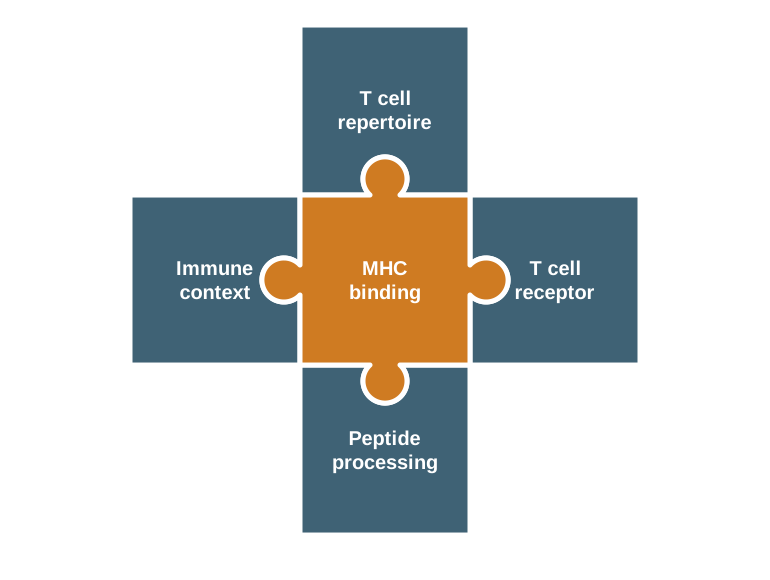
Sequencing and expression information establish a candidate source. Binding and processing predictions help prioritize experiments. Immunopeptidomics can provide evidence of naturally presented peptides, while a cellular assay asks whether a responding T cell population is present under the tested conditions.
Personalized vaccine research has demonstrated that selected neoantigens can elicit human T cell responses. That observation supports the biological rationale for testing candidates, while leaving clinical benefit as a separate question. [2]
| Evidence layer | Question it addresses |
|---|---|
| Mutation & expression | Is the candidate sequence present and expressed in the tumor? |
| Presentation | Can the relevant peptide be presented in the required HLA context? |
| T cell recognition | Does the tested T cell population respond to the candidate? |
| Target cell function | Does the response recognize an appropriate antigen-positive target? |
Build an evidence chain from sequence to function
Sequencing nominates an altered protein sequence. RNA or protein measurements establish expression. HLA-binding prediction prioritizes peptide candidates. Immunopeptidomics can support natural presentation. A T cell assay asks whether a compatible responder recognizes the candidate. These methods answer distinct questions.
Recognition of a peptide-loaded APC does not by itself demonstrate recognition of the naturally processed antigen in a tumor cell. Compare mutant and reference sequences, record the relevant HLA alleles, and include targets expressing the antigen in the intended biological context. Antigen deletion or HLA blockade can help distinguish the mechanism.
A combined eDC and target cell configuration can organize these comparisons around a defined antigen and HLA setting. Each configuration requires its own functional assessment.
Design the functional comparison
Record the antigen construct, relevant HLA configuration, immune cell source and target cell model. Where feasible, compare the mutant antigen with its wild-type counterpart and include an irrelevant antigen control. A response to peptide stimulation alone may bypass processing steps that matter when a target expresses the full antigen.
For a cytolysis endpoint, verify antigen and HLA status in both target variants. Include target-only background, appropriate HLA controls and defined effector-to-target ratios. An apparent difference between two targets can have several explanations if both antigen and HLA change at once.
Relevance to eDC research
An antigen-expressing eDC configuration offers a defined APC component for a validation experiment tailored to the study. A paired target cell model can extend the question from stimulation to target recognition. The appropriate configuration and validation requirements should be agreed for the intended antigen and immune cell source.
A positive in vitro result is evidence within that experiment. A negative result can reflect antigen processing, HLA compatibility, the sampled T cell repertoire or assay sensitivity. Neither outcome alone predicts what will happen in a patient.
References
- Wells DK et al. Key Parameters of Tumor Epitope Immunogenicity Revealed Through a Consortium Approach Improve Neoantigen Prediction. Cell. 2020. DOI: 10.1016/j.cell.2020.09.015.
- Ott PA et al. An immunogenic personal neoantigen vaccine for patients with melanoma. Nature. 2017;547:217–221. DOI: 10.1038/nature22991.