Antigen-expressing eDC line
CATALOG NUMBER · CR-C54-2MD54.2
MAGEA3-expressing eDC line
A renewable human APC research tool expressing full-length MAGEA3, typed HLA-A*02:01 / HLA-A*24:02.
Overview
MD54.2 is an antigen-expressing eDC line designed for MAGEA3-related antigen presentation and T cell research. It expresses the whole MAGEA3 protein, so epitopes arise through the eDC’s own antigen processing instead of being supplied as a fragment or peptide, creating a defined starting configuration for testing an immune response.
All MD54 lines are typed HLA-A*02:01 / HLA-A*24:02. The series is therefore suitable for studying HLA-A*02:01- or HLA-A*24:02-restricted antigen presentation. Expression of the full-length antigen does not by itself establish processing or presentation of a given epitope in either HLA context. These questions require peptide-specific and functional evidence.
For drug target discovery, connect the APC configuration to an appropriate effector population and target cell model. HLA blockade, antigen controls and viability measurements help distinguish recognition from nonspecific changes in assay signals.
Technical specifications
| Attribute | Current information |
|---|---|
| Product name / catalog number | MD54.2 · MAGEA3-expressing eDC line · Cat. No. CR-C54-2 |
| Antigen construct | Full-length MAGEA3 (whole antigen); construct details to be added |
| HLA typing | HLA-A*02:01 / HLA-A*24:02 |
| Cell system | Human eDC line in an antigen-expressing configuration |
| Format & quantity | To be specified for MD54.2 |
| Expression / presentation evidence | Antigen expression characterization and peptide-specific presentation evidence to be added |
| Quality documentation | Line identity, mycoplasma testing, microbiological testing and culture performance documentation to be added for the offered material |
| Recommended passage window | To be established from growth and functional characterization of the line |
Growth conditions & culture development
MD54.2 culture support is being developed as a growth factor cocktail. The formulation must be evaluated for cell recovery, viability, growth, antigen expression and APC function across the intended culture interval.
| Culture attribute | Development information |
|---|---|
| Basal medium reference | MD54 source line documentation lists RPMI 1640 with 10% FBS, or X-VIVO with 5% serum replacement. Final MD54.2 conditions remain to be confirmed. |
| Vessel & starting density | Source line reference: T25 flask; 0.5–1.5 × 10⁶ cells/mL. These are development starting conditions, not a validated MD54.2 protocol. |
| Medium renewal | Source line reference: approximately 2–3 times per week; optimize for the chosen cocktail and cell density trajectory. |
| Proposed growth factor cocktail | IL-2-Fc4, IL-15SA-Fc4 and FLT3L-Fc4 are candidate components. Final composition, activity units, concentrations and feeding schedule are under development. |
| Growth pattern | Adherent growth is described for the MD54 source line family; assess morphology and recovery for the engineered MD54.2 configuration. |
| Handling & release documentation | Final instructions will define thawing, culture support, recovery, sampling and product-specific testing. |
No optimized cocktail recipe or performance specification is presented here. Source line culture details guide development and must be verified for the antigen-expressing product.
Data & Figures
 Download original figure
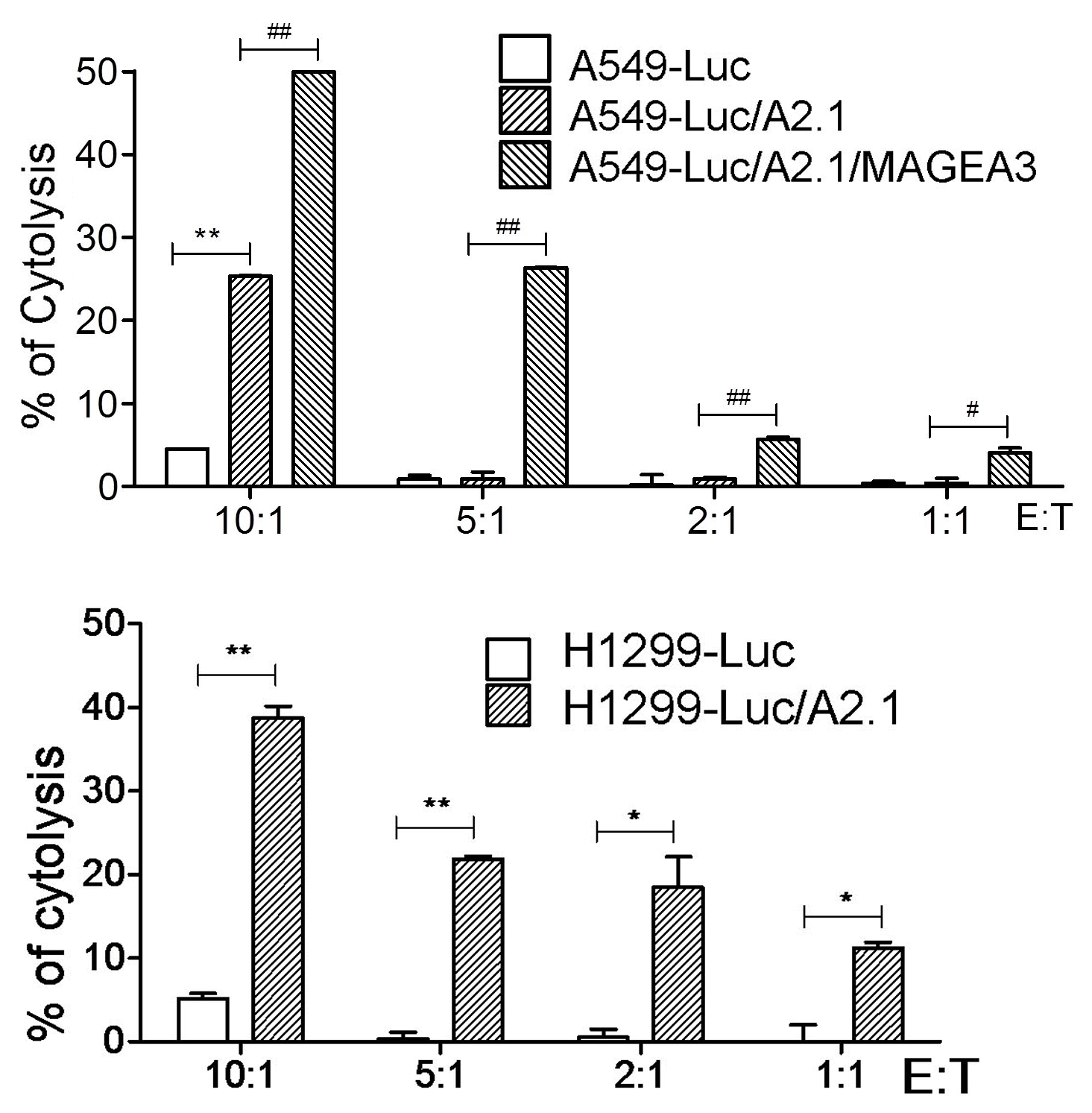
Figure 1 / Functional data
Target cell configuration changes the response
This MAGEA3 study examines eDC-stimulated cytotoxic T lymphocytes against lung cancer target cell models.
- A549 comparison
- A549-Luc, A549-Luc/A2.1 and A549-Luc/A2.1/MAGEA3 target cells.
- H1299 comparison
- H1299-Luc and H1299-Luc/A2.1. The source describes H1299 as expressing endogenous MAGEA3.
- Readout
- Percentage cytolysis across E:T ratios.
- Interpretation
- The pattern shows why both antigen expression and the relevant HLA context must be considered when selecting a target cell model. Activity varies with target configuration and E:T ratio.
Product documentation
| Document | Status |
|---|---|
| MD54.2 product information sheet | Content reserved |
| HLA typing and MAGEA3 specification | Content reserved |
| Culture & handling instructions | Under development |
| Characterization and quality report for the line | Content reserved |
Product documentation will distinguish configuration information from lot-specific testing. The research figure above is a research example related to MD54.2 and is not an MD54.2 release certificate.
Publications
Induction of antitumor cytotoxic lymphocytes using engineered human primary blood dendritic cells
Wu L, Zhang H, Jiang Y, Gallo RC, Cheng H. 115(19):E4453–E4462. DOI: 10.1073/pnas.1800550115.
View publicationCytotoxic lymphocytes induced by engineered human dendritic cells mediate potent anti-leukemia activity
Zhao C et al. 74:117. DOI: 10.1007/s00262-025-03971-y.
View publicationSelected publications provide scientific context. Consult the documentation for the specific eDC configuration when assessing product suitability.