Identity and antigen configuration
Culture history and documented handling
Functional evidence at defined passages
Banking begins with a defined research material
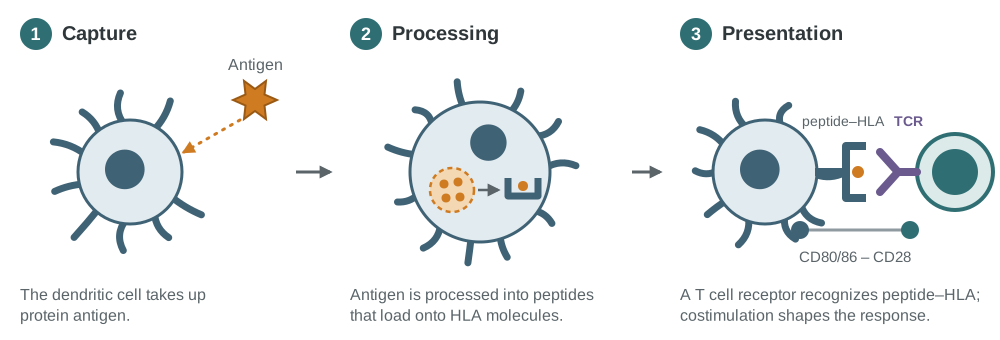
Using a characterized cell stock gives repeated experiments a common starting point. For an APC resource, that starting point should be described by its cell identity, antigen configuration, relevant HLA information and culture history.
The biological purpose matters as much as the inventory. A line intended to stimulate a response to one antigen may not address another study without additional engineering and characterization. A useful catalog therefore links each antigen-defined configuration to the question it is intended to support.
Connect the cell bank to its biological purpose
A stored APC is useful because of the question it can help answer. Antigen uptake, intracellular processing, peptide–HLA presentation and T cell recognition are related steps, but evidence at one step does not establish the next. For a selected antigen-expressing eDC configuration, document the construct and HLA context, then assess the intended response with relevant functional controls.
A renewable source can support repeated experiments. Confirm identity, culture condition and functional suitability across the research material used in the study.
A freezer inventory is only one part of the system
Cell line guidance emphasizes identity, contamination control, appropriate handling and traceable records. Banking and routine culture should preserve the link between the material used and the documentation that describes it. [1]
For eDC research, additional questions specific to the configuration include antigen expression, relevant APC phenotype and functional activity at the passages being used. These measurements complement general cell quality checks. A correct identity does not establish the biological endpoint, and an active assay does not replace an identity check.
Describe the evidence researchers need
| Information | Experimental value |
|---|---|
| Identity & provenance | Supports traceability of the cell material |
| Antigen & HLA configuration | Defines the intended immune interaction |
| Recovery & culture history | Connects an assay result to the material’s state |
| Antigen stability | Examines whether the intended configuration persists |
| Functional assessment | Tests the endpoint relevant to the research use |
| Applicable quality testing | Helps identify contamination or identity problems |
Evaluate renewal and function together
Renewal can support repeated use of a cellular configuration, but growth alone is insufficient. Investigators should assess whether the properties relevant to their study remain suitable over a defined culture interval.
A comparison across passages should record culture conditions, sampling points and assay criteria. If a result changes, the cause could involve cell state, antigen expression, assay inputs or culture history. These possibilities should be examined before attributing the change to a single factor.
Selecting a configuration for repeated studies
CrossRelay’s products are antigen-expressing eDC configurations, paired eDC/target cell systems and cytokines for culture. A research bank can organize the characterized antigen-defined materials behind these products. It does not require offering an unmodified DC line for sale.
For custom development from customer PBMCs, the requested antigen and genetic modifications should be connected to agreed confirmation and functional evidence. This research framework makes no claim about clinical suitability, regulatory status or a therapeutic cell bank.
References
- Geraghty RJ et al. Guidelines for the use of cell lines in biomedical research. British Journal of Cancer. 2014;111:1021–1046. DOI: 10.1038/bjc.2014.166.