Subset and source
Stimulus and target features
Expansion, viability and function
Specify which γδ T cells are being studied
γδ T cells express a gamma delta T cell receptor rather than the alpha beta receptor characteristic of conventional T cells. They comprise biologically distinct populations, so a result in one subset should not be generalized to all γδ T cells.
A research description should identify the population being used, its source and the recognition pathway under investigation. Broad statements that all γδ T cells behave identically, recognize every tumor or have universal therapeutic compatibility obscure those experimental distinctions.
Recognition requires the appropriate molecular context
For the Vγ9Vδ2 population, phosphoantigen sensing involves butyrophilin-associated interactions. Independent studies identified BTN2A1 as a critical component and established its cooperation with BTN3A1 in this recognition system. These findings establish mechanism-specific questions for Vγ9Vδ2 research. [1] [2]
The practical implication is that conventional peptide–HLA assay logic cannot simply be transferred to every γδ T cell study. The recognition context should be defined for the specific population and stimulus.
Measure population growth and function separately
A higher cell count does not demonstrate improved target recognition or cytotoxicity. Expansion, viability, population composition and target cell function should be assessed as separate outcomes.
| Outcome | Interpretation question |
|---|---|
| Expansion & viability | Did the intended viable population increase? |
| Population composition | Which γδ subset and other cells are present? |
| Recognition dependence | Which stimulus or target feature is required? |
| Cytotoxic function | Is there activity against the intended target? |
| Repeat stimulation | Does activity persist under the tested culture history? |
Build a comparison that fits the mechanism
Compare stimulated and unstimulated conditions, document target cell features and include relevant perturbations where the study requires a mechanistic conclusion. Keep viability and effector-to-target ratios in view when assessing cytolysis.
If a CAR is introduced, endogenous recognition and CAR-dependent activity become distinct questions. A suitable comparison should examine the CAR target and the background activity of the same cell population rather than assuming that both mechanisms contribute equally.
Frame γδ T cell studies that use an APC as testable questions
An eDC-based study would need to establish that the selected configuration supports the intended γδ population and endpoint. Expansion yield, population purity and functional activity require direct data for that configuration.
This article does not establish an eDC product for γδ T cell expansion or a cell therapy manufacturing capability. It identifies research considerations for discussing a potential custom project. Therapeutic safety and effectiveness require separate evaluation and cannot be inferred from an in vitro response.
References
- Rigau M et al. Butyrophilin 2A1 is essential for phosphoantigen reactivity by γδ T cells. Science. 2020. DOI: 10.1126/science.aay5516.
- Karunakaran MM et al. Butyrophilin-2A1 Directly Binds Germline-Encoded Regions of the Vγ9Vδ2 TCR and Is Essential for Phosphoantigen Sensing. Immunity. 2020;52:487–498.e6. DOI: 10.1016/j.immuni.2020.02.014.
Reading the population data
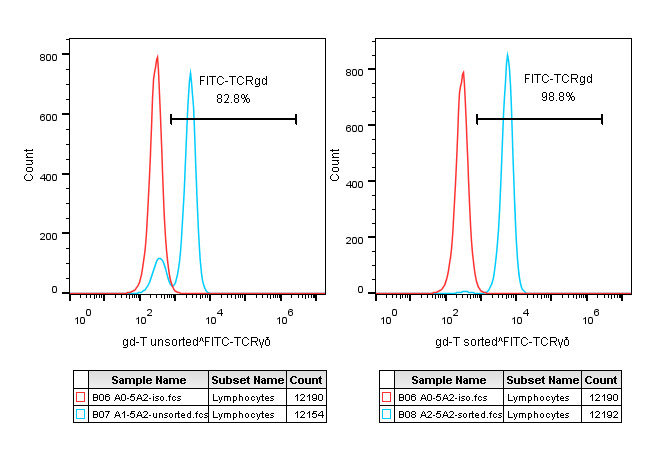
Sorting changes the observed population composition. A high gated percentage does not establish the absolute yield, subset identity, purity across donors or tumor-reactive function. Those questions require additional phenotype, counting and functional measurements.