Immune communication is bidirectional
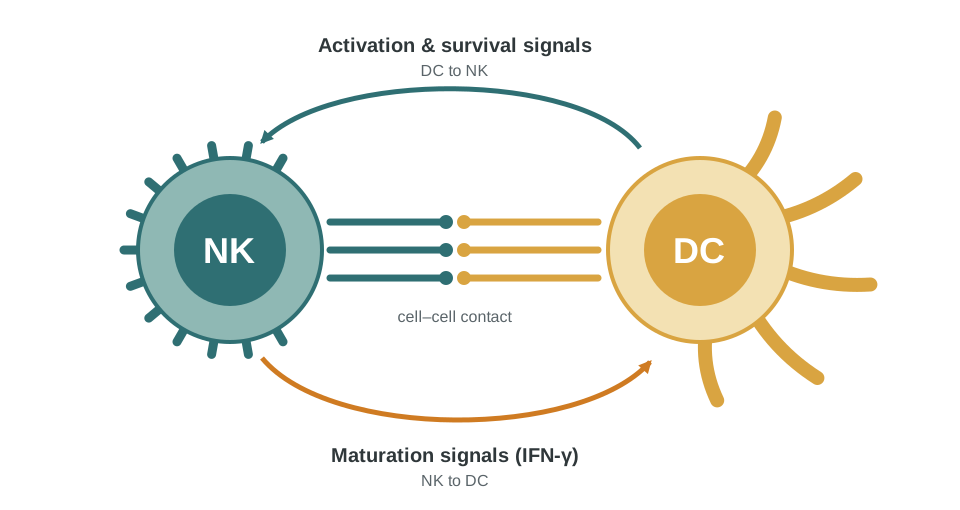
DC–NK interactions provide a useful research setting for separating cytokine-mediated signals from cell contact effects. Human DCs can activate resting NK cells, while activated NK cells can respond differently to DCs according to their maturation state. These relationships depend on the experimental conditions. Primary study: Ferlazzo et al., 2002 ›
In a separate human DC–NK study, cell contact and NK-derived IFN-γ and TNF contributed to DC maturation. The direction of the effect should therefore be measured rather than assumed. Primary study: Gerosa et al., 2002 ›
For an APC drug discovery experiment, distinguish the effects on APC state, effector cell composition and target cell susceptibility. A compound that reduces target killing may affect any one of these components.
Distinguish contact, cytokines and effector function
DCs and NK cells can influence one another through cell contact and soluble signals. NK-derived IFN-γ can affect the DC response; APC-associated cytokine signals can support NK activation in appropriate conditions. The outcome depends on the activation state and compatibility of both populations.
A study can compare direct coculture with a separated cell condition, assess cytokine contribution and measure target cell activity independently. When investigating IL-15-related mechanisms, distinguish soluble supplementation from cell-associated presentation and verify the relevant components.
For persistence-related questions, track viable effectors and functional activity across repeated challenge rather than equating cell survival with sustained killing. DC–NK biology is included here to inform research design.
A functional research example
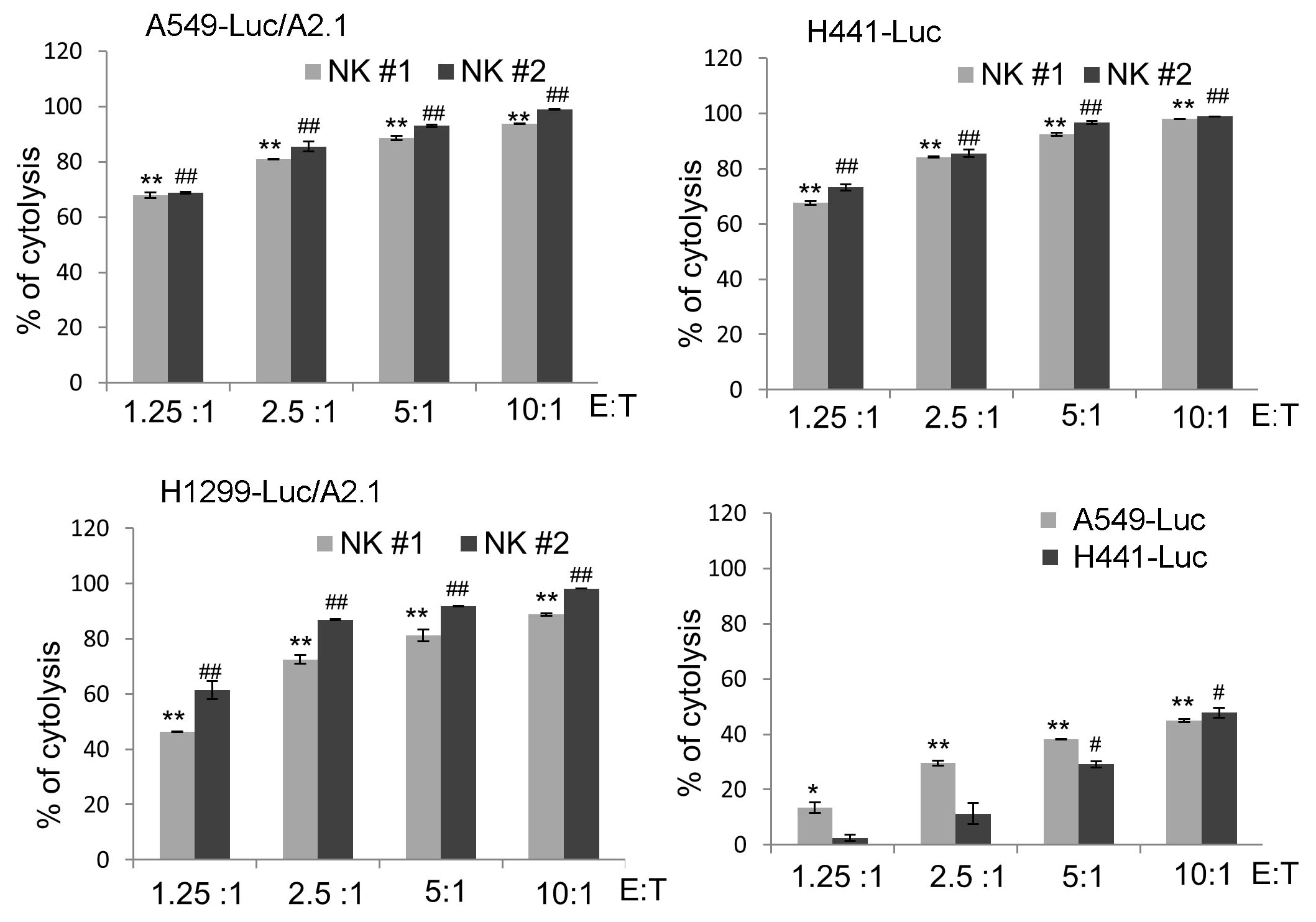
The dataset illustrates target cell and effector population comparisons. It does not alone demonstrate the mechanism behind a response. HLA independence, receptor dependence and antibody-dependent activity require their own appropriately controlled tests.
Separate composition, signaling and killing
| Question | Useful experimental approach |
|---|---|
| Which effectors are present? | Measure population composition, viability and absolute cell counts; report NK and T cell contributions separately. |
| Is contact required? | Compare direct coculture with an appropriate contact separation condition; interpret alongside viability and cytokine measurements. |
| Which interaction contributes? | Use receptor/ligand perturbation and matched controls. A ligand-positive target comparison alone does not prove receptor dependence. |
| Does function change? | Measure target cell cytolysis across defined E:T ratios and assay times, including effector-only and target-only controls. |
Population expansion, activation marker expression and cytolytic activity are related but distinct outcomes. Measure the endpoint relevant to the research question and define biological replicates before interpreting a difference.
Connect the biology to a focused study
The DC–NK material is included here as scientific context for immune communication and functional assay design. CrossRelay’s product catalog remains focused on antigen-expressing eDC lines, paired cellular assay systems and cytokines for culture.
Plan the controls and readouts